



Torts and Negligence
A tort is generally defined as a violation of another’s rights. Torts can be further divided into two main categories: intentional torts and negligent torts. An intentional tort is a wrongful act intended to inflict injury upon another. For example, punching someone in the face is an assault. On the other hand, a negligent tort occurs due to the failure to exercise ordinary care in a given situation. For instance, failing to stop at a red light and causing damage to another vehicle. The primary difference between intentional and negligent torts lies in the intent behind the wrongdoing. A negligent tort is not committed with the intention to harm another individual.
The purpose of negligence law is twofold: it serves as compensation for individuals injured through no fault of their own; and it incentivizes everyone to behave reasonably. A motorist who believes he is financially liable for any accidents caused by him is likely to refrain from distractions while driving, such as talking on cell phones.



Elements of Negligence
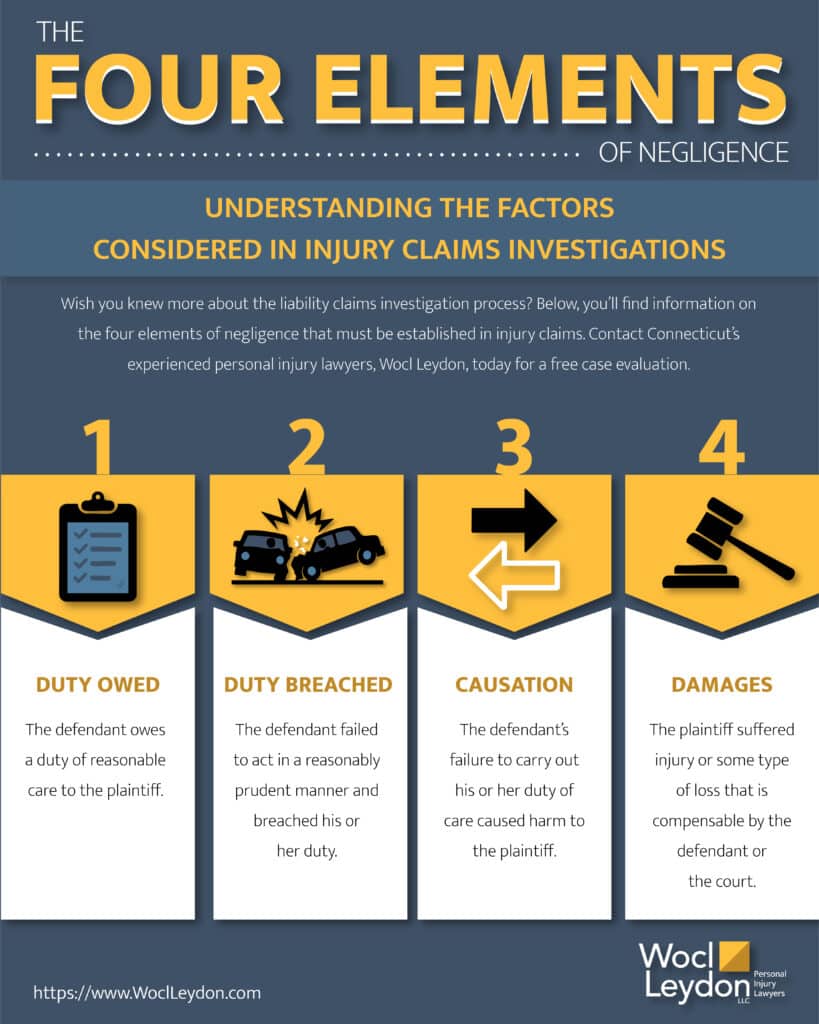
In order to successfully prosecute a negligence action in Connecticut, a plaintiff must satisfy the following four elements. If a plaintiff fails to demonstrate any one of the elements, then the lawsuit will fail. The following is an explanation of what each element entails.
Duty
Each negligence claim begins with the inquiry: Did this person owe you a duty of care? The answer is usually affirmative since duties exist nearly universally. Motorists owe a duty to other motorists and pedestrians; property owners owe a duty to visitors to maintain reasonably safe conditions; doctors owe a duty to their patients to render care consistent with acceptable standards of medical professionals; employers owe duties to employees to create and maintain safe working conditions.
Common law or statutory law can give rise to obligations based on common sense, yet statutory law also places obligations on parties. Statutes addressing roadway safety, workplace safety, and licensure standards for professionals are examples of law which obligate parties and create duties.
Examples include:
- A motorist approaching an intersection owes a duty to comply with traffic signals;
- A grocery store owner owes a duty to clean up spills prior to allowing customers to enter areas where they may potentially slip;
- A surgeon owes a duty to operate on a patient utilizing the level of skill and care which would normally be employed by a skilled surgeon. These are not abstract concepts. Rather, they represent minimum expectations in terms of behavior which, when breached, form the basis for claims.
Breach
Identifying that a duty exists merely satisfies one aspect of demonstrating negligence. A second issue is identifying that said duty has been breached — i.e., the defendant has acted in a manner inconsistent with how a reasonable person would have acted under similar circumstances.
The courts frequently employ a balancing approach referred to as the Learned Hand formula in determining whether a duty has been breached. To avoid delving too deeply into theoretical aspects of law, I will simplify this concept. The basic premise is as follows: A duty will be considered breached more readily when:
- there is a significant likelihood of injury occurring;
- the possible injury is very serious;
- preventing said injury is very inexpensive compared to its potential consequences. As an example, a driver observing a pedestrian entering a crosswalk and looking away from the road to send/receive messages on her cellular telephone represents an obvious risk of serious injury (high likelihood/high severity); and keeping her hands on the wheel and eyes on the road (i.e., avoiding texting) would have no negative monetary consequences. Therefore, she has clearly breached her duty.
Additional examples that arise in our firm’s cases are:
- A landlord aware of broken stair railings who chooses not to repair them for several weeks;
- A nurse administering incorrect medications despite clear labels indicating proper dosages;
- Trucking companies pushing drivers beyond federally mandated hours-of-service limits;
These are all breaches of duty because in each scenario, a reasonable person/company would have acted differently.
Causation
While some cases appear straightforward regarding the existence of duty and/or breach, many cases become complicated concerning causation (even though duty and breach appear evident).
There are two components of causation:
Causation in fact seeks to determine whether an injury would have occurred regardless of defendant’s actions/omissions. The “but for” question is used as the classic test. The “but for” question essentially inquires: Would you have sustained this injury absent defendant’s negligence? If the response is “no”, causation in fact is presumably established.
Proximate Cause seeks to determine whether defendant’s breach resulted in foreseeable consequences. This establishes boundaries of liability for outcomes that could have reasonably been anticipated by defendants. For example, if a distracted driver rear-ends you, resulting in you breaking your wrist, this outcome is foreseeable. If the exact same accident somehow triggers an unrelated series of events resulting in additional injuries to a third party located three miles away, the link between defendant’s conduct and subsequent injuries may become weak enough so as to deny recovery.
As an example: Driver runs red light and strikes pedestrian. Pedestrian sustains broken leg during hospitalization and develops complications from surgical procedures as a result. Can driver be held accountable for development of complications? Generally yes, because medical treatment for injuries stemming from automobile accidents is deemed foreseeable as part of the normal course of treatment for related injuries.
Chain of Causality Continues
Damages
Even if all four necessary elements (duty, breach, causation-in-fact, proximate cause) are proven in favor of plaintiff, negligence claims still depend on actual harm being incurred by plaintiff. Plaintiff cannot recover damages solely for nearly injuring himself/herself.
Personal Injury Damages
Connecticut recognizes various types of damages that plaintiffs can seek compensation for:
Economic Damages represent quantifiable financial losses: medical expenses (past/future), wage loss, diminished ability to earn income, and increased expenses associated with items such as rehabilitation equipment or physical therapy.
Non-Economic Damages address tangible issues which can be difficult to measure: pain/suffering, emotional distress, decrease/enjoyment-life experience/disfigurement/decrease companionship.
Punitive Damages are less commonly awarded. In Connecticut, punitive damages can only be awarded upon proof of willful/wanton misconduct: defendants must exhibit conscious disregard for another person’s well-being. For example, a drunk driver convicted multiple times for previous DUI offenses injures a pedestrian and is therefore eligible for punitive damages. On the other hand, a driver operating a vehicle while distracted by ss via mobile device is unlikely to incur punitive damages.
Evidence Necessary to Prove Negligence
Demonstrating the four required elements to establish negligence is inconsequential unless you have sufficient evidence supporting each element. Since establishing that the plaintiff can prove each element is vital for the plaintiff to establish the prima facie case for negligence, having adequate evidence for establishing each element will significantly increase success rates.
Types of Relevant Evidence in Establishing Negligence Claims
Most relevant forms of evidence include:
Incident Reports / Police Reports – Incident reports/police reports are among the first formal documents detailing incidents involving alleged negligence. While police reports are rarely capable of assigning responsibility for the incident, police reports detail important specifics including time/day/weather/etc.; identify independent witnesses; and list any charges/citations issued as a direct result of said incident.
Medical Records – Medical records detailing treatment rendered and continued health effects due to negligence are valuable in establishing that injuries resulted directly from negligence and not from pre-existing conditions.
Photos/Videos – Photographs and videos depicting accident scenes; documenting injuries/damage; showing hazardous conditions are substantially more effective than written descriptions of incidents.
Witness Statements – Witness accounts of incidents that occur independently confirm plaintiff’s versions of events – particularly useful when defendants assert alternative versions of occurrences.
Expert Testimony – Complex cases may utilize expert testimony to bridge gaps between facts/legally applicable principles. Accident Reconstruction Experts can describe probable sequences of events leading to accidents; Medical Professionals can describe both nature/long-term impacts of plaintiff’s injuries; Medical Malpractice Cases require testimony from physicians who meet qualifications as competent peers in treating similarly situated patients.
Plaintiff Documentation – Maintain daily journals beginning immediately after alleged negligence occurred. Document chronic pain levels; documented inability to engage in activities previously able; document changes experienced throughout your life. Record every medical bill; document every visit/appointment; maintaining timely contemporaneous documentation can be highly beneficial at depositions/trial.
Comparative Negligence and the 51 percent Rule in Connecticut
 In Connecticut, we operate on a form of Comparative Negligence. This is a simplified way of saying that you could be found partially at-fault for an occurrence and still obtain recovery, but your recovery would be reduced according to your portion of fault. In addition, you may recover only if your share of negligence is 50% or less. If you are 51% or more at fault, recovery is barred, and any recovery is reduced by your percentage of fault.
Exceeding fifty-one (51%), you will recover no amount
As exemplified in the following illustration. Let us assume you were involved in a motor vehicle collision and the jury determined your total damages were one hundred thousand ($100,000). Further, the jury also found that you were thirty (30) percent at fault due to speeding. Therefore, your award would be reduced by thirty (30) percent, and you would receive seventy thousand ($70,000).
Let us now illustrate another example. Assume the identical collision occurred except for the fact that the jury determined that you were fifty-five (55) percent at fault. Pursuant to Connecticut’s modified Comparative Negligence statute, you would be entitled to no recovery.
This is distinct from pure Comparative Negligence jurisdictions, wherein a plaintiff who is ninety (90) percent at fault can still recover ten (10) percent of his damages. Conversely, it is distinct from those jurisdictions employing a Contributory negligence rule (still utilized in several jurisdictions), whereby any degree of plaintiff fault completely bars recovery.
Therefore, in Connecticut, we employ a hybrid methodology that falls somewhere in-between.
Practically speaking, how much fault is attributed to you in your case is paramount. Insurance adjusters and defense attorneys are well aware of this reality. Consequently, these individuals will search for any evidence that demonstrates you bore some measure of responsibility for the occurrence, since even a slight alteration in the allocation of fault percentages can substantially decrease your recovery. An experienced attorney representing you who effectively tells your side of the story and minimizes any allocated fault will greatly enhance the likelihood of maximizing your actual net recovery.
Frequently used legal terms regarding types of negligence & specialized doctrine
There are a couple of specialized doctrines/legislative statutes frequently cited in Connecticut negligence cases. Understanding each concept helps:
Negligence per se:
When a defendant commits a statutory infraction resulting in harm to another person or property (and such statute is intended to safeguard persons or property), the defendant’s conduct is considered negligence per se. For instance, a driver texting while operating her vehicle, which is prohibited in Connecticut, and colliding with you establishes negligence per se. However, you still need to demonstrate causal connection and proof of damages. The court will consider the statutory violation as having established the breach component.
Gross negligence/wantonly/malicious conduct:
Ordinary negligence represents a careless deviation from reasonable care. Gross negligence/willfully/wanton misconduct demonstrates an egregious lack of regard for the safety of others. Gross negligence/maliciousness can lead to punitive damage awards and can dramatically alter the tone/tenor of the action.
Vicarious liability:
Employers are generally vicariously liable for the negligent actions of their employees conducted during the scope of employment. As illustrated in the previous paragraph regarding delivery drivers and auto accidents, vicarious liability applies similarly to the owner(s)/operator(s) of vehicles (e.g., family car doctrine), whereby owners/operators may be liable for accidents caused by family members using their vehicles.
Assumption of risk:
Defendants may attempt to assert an assumption-of-risk defense in tort actions; i.e., that the plaintiff knowingly assumed a particular risk. Assumption-of-risk defenses are most commonly seen in recreational settings. Although an assumption-of-risk defense may potentially impact damages under the comparative fault framework, it will not preclude liability entirely.
Contributory fault:
Although many attorneys utilize the terms “Contributory negligence” and “Comparative Negligence,” technically speaking, Contributory negligence refers to the old Contributory negligence standard employed in a limited number of jurisdictions — i.e., any degree of plaintiff fault totally bars recovery. Connecticut abandoned this standard. More accurately stated, in most instances when defendant counsel argue Contributory negligence in modern Comparative Negligence jurisdictions, they are contending that plaintiff shares a certain level of blame for causing injury to themselves, thereby reducing plaintiff’s potential recovery under Comparative Negligence principles.
We're Here to Help.
Limitations statutes & other procedural issues
The prior discussion referenced a two-year statute of limitations applicable to most personal injury claims. However, there are exceptions to the general rule:
Medical malpractice claims
For medical malpractice claims, the general statute of limitations is two (2) years from the date of injury or from when plaintiff reasonably should have discovered their injury. In addition to the statute of limitation period, there are additional procedural hurdles related to filing certificates of good faith and obtaining qualified medical opinions prior to commencing litigation.
Claims against government entities/municipalities
For claims filed against governmental entities/municipalities, written notice of the alleged injury must be given to the governmental entity/municipality prior to commencement of litigation. The deadlines vary depending upon jurisdiction; however, common examples include 90-day and/or 6-month notices. Failure to comply with these deadlines will result in dismissal of the claim regardless of whether plaintiff has a valid cause of action.
Minor claimants
For minor claimants (i.e., children), the statute of limitations typically begins to run when the child reaches age eighteen (18).
While failure to timely comply with the statute of limitations may serve as a bar to recovery regardless of merit in a claim, there are practical reasons to pursue your claim expeditiously. Physical evidence disappears. Memories fade. Witnesses relocate or cannot be located. Video surveillance evidence becomes outdated. The faster an attorney can commence preservation/evidence collection efforts for your case, the better position your case will be in for successful resolution.
Actions following an injury due to another’s negligence
The manner in which you address issues subsequent to an injury due to another’s negligence may also contribute positively/negatively to your claim:
Seek medical attention immediately.
Even if you believe you are okay, some injuries do not present immediately. Documenting your condition through immediate medical evaluation connects your injury with the incident. Defense counsel will scrutinize gaps in treatment for purposes of attempting to negate causation/damages.
Provide written notice of incident.
Whether or not you sustained physical injuries from an automobile accident (in which case you should notify law enforcement); suffered a work-related injury (in which case you should notify your employer); or sustained a slip/trip/fall-type injury at a commercial establishment (in which case you should request an incident report), documenting events at the time of occurrence can help support your claim.
Document all available information.
Take photographs of your injuries and surrounding conditions. Write down details of what happened as soon as possible while memories are still clear. Obtain witness identification/contact information as applicable.
Exercise caution when providing statements to insurers.
Insurance representatives are skilled at extracting damaging admissions from claimants. You are not required to provide an oral/video taped statement to another party’s representative without consulting an attorney first. Consulting an attorney prior to providing statements to insurers is advisable in virtually all situations.
Engage representation early.
The sooner you retain an attorney who can assist you with gathering evidence; meeting procedural obligations; protecting your interests; etc., the greater chance you will have of achieving optimal results in your case.