


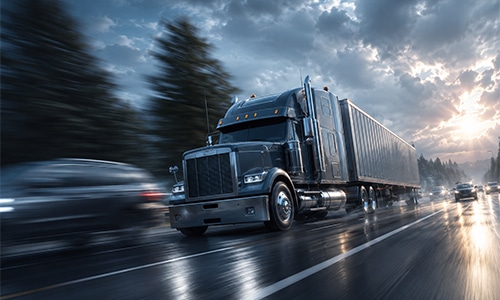
At Wocl Leydon, we help individuals injured in accidents involving large vehicles understand their legal options. Our lawyers practicing law in Connecticut can assist in determining liability and which path would be most beneficial to pursue for seeking monetary compensation: through a settlement with an insurance company, a court action, or both.



What Makes a Truck Accident Lawsuit Viable?
Being hit by a truck does not automatically mean the truck owner/operator is liable. To prevail in a negligence lawsuit, you are required to prove the following:
- That you were owed reasonable care;
- The defendant did not meet their obligation to reasonably care for you;
- As a result of their failure, you suffered damages (i.e., physical injury and/or financial loss) due to the accident.
For example, if we can show through the evidence that the driver was tailgating your vehicle when they rear-ended you at a stop, that may be sufficient evidence to support a valid negligence claim. In addition to establishing causation through medical records, we must connect the accident directly to the injuries/losses you are seeking reimbursement for.
Any person involved in the incident, including a driver, passenger, pedestrian, or cyclist, may have grounds for a claim if another party’s negligence caused that person injury or loss. You do not have to determine if the driver was distracted/fatigued before submitting your request for a case evaluation. This is something we investigate as part of your case.
Who Can Be Held Responsible?
The truck driver could be liable for carelessness while operating the vehicle.
Additionally, the trucking company could be found at fault due to its own actions or inaction, which could show it failed to ensure the vehicles were safe to operate on public roads.
A company can be held liable for the actions of an employee who is driving a vehicle if the employee was acting within the scope of their employment and in furtherance of the company’s business at the time of the accident.
Other possible defendants include a repair shop that negligently repaired a part of the truck, a cargo loader, and possibly other drivers of automobiles. If evidence shows a defect in one of the truck’s components contributed to the accident or your injuries, you may also have a product liability claim based on that defect.
Can I Sue for Being Hit by a Semi Truck if I Was Partly at Fault?
Generally, you can recover in a negligence case as long as your degree of fault is not greater than the total fault of the people or companies you are seeking compensation from. So this means 50% fault can still lead to some compensation, but more than 50% fault will generally result in no recovery.
What Compensation Can a Claim Include?
The types of compensation you are entitled to may depend on the evidence supporting your claim. Compensable items may include: medical care for your injuries, physical therapy/rehabilitation for recovery, loss of income due to your inability to work, diminished earning capacity, damages to your personal property (e.g., car), and the amount of pain and suffering you endured as a result of your injury. The Connecticut courts distinguish economic damages from non-economic harms.
Our lawyers will examine how your injuries affect your ability to work, the medical treatment you need, and how your injuries affected your day-to-day life. To learn about how we value injuries suffered in an eighteen-wheeler collision, click here.
How Can I Sue for Being Hit by a Semi-Truck?
How Long Do You Have to Start a Connecticut Lawsuit?
Ordinary negligence injury claims: Generally, Connecticut has a two-year statute of limitations, meaning a person has two years from the date the injury was first sustained or discovered, or reasonably should have been discovered, to file suit. However, sometimes, a lawsuit can be filed up to three years after the negligent act or omission that caused the injury.
Claims based on other torts may be subject to different time limits. Simply because a child suffers a serious injury and is receiving ongoing treatment or negotiating with an insurance company does not necessarily mean that there are additional time limits beyond those set forth above.
Generally, Connecticut state court lawsuits are commenced through legal process, including a summons and complaint that must be properly served on the defendants. Contacting an insurance company does not constitute filing a lawsuit. To ensure you identify and properly serve all potential defendants, seek counsel as soon as possible.
We're Here to Help.
What Should You Do to Protect Your Claim?
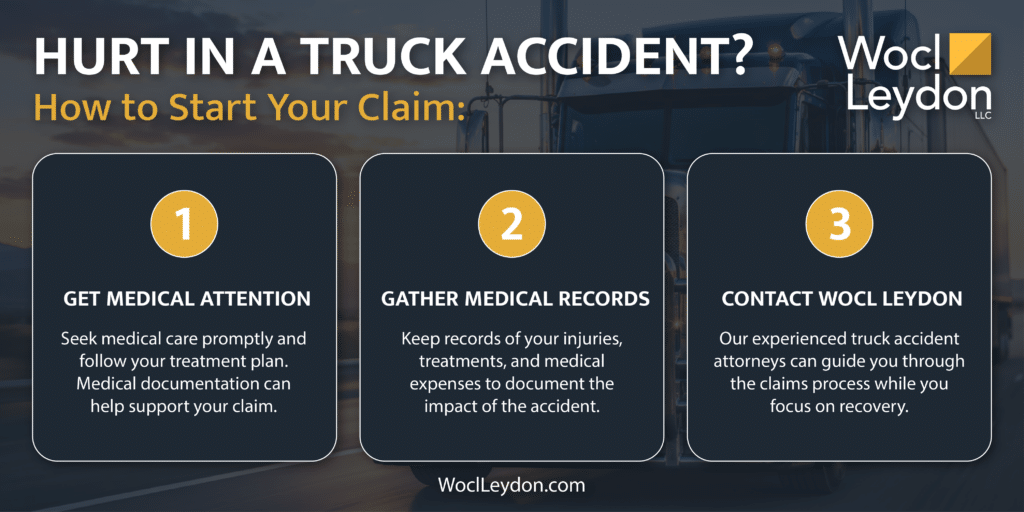
Start by contacting a doctor and creating an accurate record of what happened. If your injuries prevent you from gathering the needed documentation at that time, tell your attorney what you do know about the accident so you don’t delay consulting with one.
Save the documentation related to the incident. Record the report number (if applicable), contact information for the driver(s) involved, name of the trucking company, and any photos you have taken at the scene of the accident.
Protect your other records. Store the original video footage, witness contact information, medical expenses incurred because of this collision, payroll records showing lost wages due to this accident, and any communication (messages, emails, etc.) that relate to the collision.
Request all truck-related materials as soon as possible. Items such as driver’s logbooks, dispatch messages, vehicle maintenance records, and/or video cameras may provide important evidence for your claim.
Carefully read any insurance-related documentation. Before signing anything that would be considered a release form, and before providing a recorded statement to the trucking company’s insurance provider, get legal counsel. Review your insurance policy for coverage, and review any required notice provisions and cooperation obligations.
Under FMCSA guidelines, carriers must maintain drivers’ duty records and supporting documentation for six months after receiving them. There could be different retention limits for other types of evidence. Submit a preservation request to protect relevant evidence before it is routinely deleted or before vehicle repairs occur.
To obtain copies of reports filed by Connecticut State Police, go to the DESPP Reports and Records webpage and follow the correct procedure for obtaining those reports. Serious injury reports will likely need a different type of request than standard reports obtained via a public access portal online.
How an Insurance Claim Becomes a Lawsuit?
Insurance claims are requests for the insurance provider to settle your loss under the policy terms. Litigation (lawsuits) involves filing a complaint in court to establish who was at fault and how much compensation should be awarded. Settlement negotiations can continue even while litigation is ongoing.
Our lawyers will review all the evidence to identify who may be liable, document your financial losses, and negotiate with insurance companies. Once we determine that litigation is an appropriate course of action, this process typically includes both sides exchanging documentation and witness information and preparing for trial. Simply filing a lawsuit does not automatically lead to a trial.
Legal assistance may be beneficial if the trucking company claims no liability exists; if multiple entities were involved in the collision and each blames someone else; or if the insurance company disputes whether you suffered injury(ies) resulting from the collision. All three examples require evidence specific to the disputed issue.
Talk With Wocl Leydon About Your Legal Options
In 2019, attorneys with our firm won a $18.5 million jury award for a man who was hurt after a truck driver rear-ended him on I–95 in Westport. This case involved an injury to one of the plaintiff’s lower back discs and various neck injuries; he also claimed that, as a result of this crash, he suffered long-term effects of the concussion that occurred during the collision. Past success does not guarantee future success.
We have an office located at 80 Fourth St. in Stamford. Contact us for a complimentary case consultation by calling (203) 693-9070 or reach out through our site.
Frequently Asked Questions
Can I Bring a Claim if the Driver Was Not Ticketed?
Yes. A traffic citation is not required for a civil negligence claim. In order to bring an action based upon the above-stated theory, there will need to be evidence showing that the motorist was responsible; that his actions (or lack thereof) were the direct cause of plaintiff’s injuries; and that as a result of those actions, plaintiff suffered some type of injury (i.e., economic/monetary losses).
What if I Already Had Back or Neck Problems?
While a prior condition may affect your recovery of damages for a particular aspect of your injuries, it should not bar you from recovering damages for the extent to which the defendant increased your harm through his negligent conduct. Connecticut’s jury instruction regarding pre-existing conditions addresses this issue by distinguishing the additional harm caused by the defendant from the pre-existing condition itself.
What Should I Bring to a Consultation?
It would help to gather any documentation you have related to the accident (photos, police report, etc.), along with your medical records, bills, and correspondence with your insurance company. Also, please include any documentation related to your work history. Do not worry about gathering everything you might need before meeting with a lawyer. Simply tell him/her what happened and identify who has those records.
Related Article
How Much Will You Get Paid if an 18-Wheeler Hits You? – Settlement Amount Guide
This Article Has Been Reviewed By an Attorney