


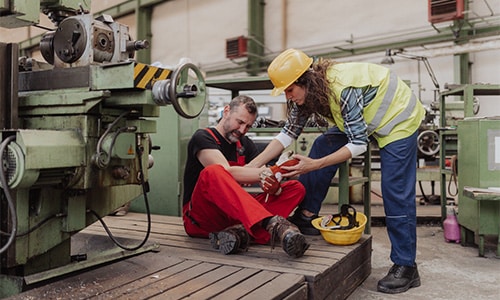
Causes of Most Common Machine Accidents
Many machine accidents don’t occur randomly. Rather, they follow predictable patterns. Recognizing these patterns is the first step in preventing them.
Caught-in or Caught-Between
Accidents occur when a part of a worker’s body is drawn into operational machinery, which may include belts, gears, conveyor systems, or presses. These are two of the most common and severe types of machine injuries, leading to crushing injuries, degloving, and amputations. There is virtually no time for reaction when a worker’s sleeve is caught in a rotating shaft.
Struck-by or Struck-Against
If a worker is hit by flying objects such as debris, a moving component, or an object propelled from a machine, the possible injuries range from bruises to death due to blunt trauma. Objects may break apart, causing punctures or lacerations upon striking a worker. If a saw blade explodes or a piece of wood or material bounces back violently, then a penetrating wound occurs in an extremely short period of time.
Exposure to Toxic Substances
While machinery creates various mechanical hazards, many produce fumes, dust, and chemicals as part of their daily operations. Prolonged exposure to these hazardous substances can cause serious lung diseases, chemical burns, and irreversible damage to vital organs, even though the worker feels perfectly well initially.
Repeated Motion and Vibration Exposure
There are numerous examples of non-dramatic machine injuries. While years of vibrating exposures from jack-hammers, rivet guns, and grinders create progressive damage to muscles, nerves, and joints, workers experiencing these types of injuries usually do not recognize the extent of the injury until it progresses significantly.
Electric Hazards
Both electrical shock and electrical burn are serious potential hazards during equipment maintenance and/or when equipment contains open wiring or malfunctions unexpectedly. Electrical shock can kill an individual with one accidental contact with energized equipment.
Related Article(s)
Faulty Equipment Lawsuits: Your Rights and Compensation After a Defective Machinery Injury



Examples of Common Machine-Related Injuries
Cuts and Lacerations
 Rotating parts and sharp tools and edges cause severe cuts that can cause tendons, nerves, and blood vessel severance. Approximately thirty percent of all workplace injuries consist of cuts and lacerations. Properly installing machine guards and providing cut-resistant gloves will greatly assist in reducing the frequency of these types of injuries. Consistently training personnel on proper handling techniques will provide additional assistance in reducing cut and laceration injuries.
Amputations and Severe Lacerations
Entanglements with rotating machinery can exceed simple surface cuts resulting in amputation of fingers/hands/arm/legs. According to OSHA records, there were over 18,000 amputations and severe laceration injuries documented annually. Frequently, these accidents occur during typical day-to-day tasks when a worker loses focus or a safety guard has been eliminated to increase productivity.
Crushing/Pinch Injuries
Forklifts and heavy equipment can exert thousands of pounds of force against a body part, resulting in crushed bones, internal bleeding, severed nerves, etc. Although less severe pinches that do not completely crush hands can remain impaired indefinitely.
Thermal Burns/Abrasions
Equipment/machine hot surfaces and sparks cause burns. Chemical splashes/steam/molten metals cause burns, depending on the degree of burns, skin grafts/scarring/infection may be required. Providing personnel with heat-resistant gloves/facial shields along with teaching workers how to recognize hazards will greatly decrease the number of thermal burns suffered on-the-job.
Repetitive Strain Injuries (RSI)
Carpel tunnel syndrome/tendinitis/bursitis type injuries develop over time from repeated movements/vibrations. Typically, early signs of RSI-type injuries include tingling/numbness/aching that the worker typically dismisses. Neglecting RSI can result in permanently disabling effects. Implementing ergonomic designs for tools/job rotations/scheduled rest periods can assist in eliminating/reducing RSI-type injuries.
Electrical/Lock-Out/Tag-Out Related Injuries
Anytime personnel perform maintenance/service on energized equipment without first safely de-energizing the equipment through lock-out/tag-out procedures, workers run the risk of electrocution/arc flash burns/cardiac arrest. OSHA regulation 29 CFR Section 1910.147 is specifically developed to address this exact concern and requires employers to implement/enforce lock-out/tag-out programs for their employees prior to performing any servicing/maintenance on energized equipment. OSHA citations for failure to comply with lock-out/tag-out regulations are commonly issued during an inspection.
Respiratory Problems: Toxins/Vapor Inhalation
Chemical vapors/welding fumes/exhaust gases/dust created by industrial manufacturing processes/respiratory problems are generally instantaneous and can cause chronic health issues, including occupational asthma/COPD/certain cancers. Provisions must be made for adequate ventilation/air quality monitoring/proper respirator use when working around these types of hazards.
Eye/Face Injuries
Debris/grinding particles/sparks/splashing chemicals cause minor eye irritations to permanent blindness. Eye & facial protective devices used by workers must be rated for the particular hazard present. Simply having PPE available is not sufficient. Personnel must consistently wear their PPE.
Hearing Damage
Long-term exposure to machine-generated noises exceeding 85 decibels causes cumulative/permanent damage to hearing. Since hearing damage develops slowly, many workers do not acknowledge hearing damage until it is significant. Using engineered solutions/hearing protection/testing workers’ hearing periodically are generally accepted methods for controlling noise levels in the work environment.
We're Here to Help.
Contributing Factors in Machine Accident Incidence
The majority of machine accidents are preventable. Generally speaking, accidents involving machines seldom occur solely due to bad luck. Below are several contributing factors involved in most accident investigations:
- Inadequate Training/Surveillance: Employees who are inadequately trained on the equipment they will operate are far more likely to commit an error that leads to an injury. Both novice employees and skilled employees assigned to unfamiliar equipment require similar training.
- Poor Maintenance/Old Equipment: Eventually, any machine not regularly checked/maintained will malfunction. Degraded guards/worn belts/deactivated sensors can convert a routine process into a potentially serious accident.
- Gaps/Disabling in Safety Guards: On occasion, machine guards are removed for faster production rates/convenience. Removing machine guards is one of the most frequent/serious shortcuts taken in the industrial workplace.
- Failure to Follow Lock-Out/Tag-Out Protocols: Several major electrical/mechanical injuries have resulted from workers attempting maintenance on machines still powered up, either because the lockout/tag-out procedures were omitted or not properly communicated.
- Production Pressure/Productivity Rate Shortcuts: When employees experience production pressure/quota deadlines/completion deadlines, safety guidelines/procedures are rapidly implemented/disregarded. Management is equally responsible as employees for production rate pressures, as well as ignoring legitimate safety complaints.
Workplace Safety Best Practices
While good safety practices are not complex, consistent enforcement by both employers/employees is necessary.
Machine Guarding
According to OSHA, any point-of-operation/part-of-a-machine that presents a hazard must be protected. Point-of-operations may include locations where material enters/exits rotating components/etc. Guards must be constructed so they cannot be easily removed and must be examined routinely. OSHA has published an excellent Machine-Guarding E-Tool explaining details associated with compliance.
Lock-Out/Tag-Out Programs
Prior to beginning maintenance/service on any machine/equipment, the power source must be safely de-energized utilizing individual locks (lock-out) or tags (tag-out). All employees who may service/perform maintenance on energized equipment must be trained regarding lock-out/tag-out procedures. Employers must also establish written policies governing each machine utilized within their facilities.
Personal Protective Equipment (PPE):
PPE provides the final layer of protection rather than the initial layer. Prior to utilizing PPE for any hazardous situation, engineering controls must be established as well as implemented; therefore, when a hazardous situation remains following implementation of engineering controls, PPE must be provided/used/maintained properly. Examples include cut-resistant gloves/goggles/shields/etc.
Employee Training/Education:
Initial training is insufficient. Employee training/refresher training/supervision for employees utilizing new equipment/proper communication channels regarding employee concerns should always exist without employee reprisals.
Vibration/Postural Injury Control:
Employers may schedule regular breaks/design jobs to rotate employees through multiple positions/provide anti-vibration tool handles/grips/gloves, etc., thus reducing cumulative trauma caused by vibrations/posture.
Emergency Response Planning:
Each facility should have easily accessible emergency shutdown switches/emergency response plans/published incident reporting procedures/emergency first aid kits located close to equipment/training for employees responding to emergencies for their own medical treatment purposes as well as preserving critical evidence.
Establishment of Workplace Safety Culture:
Without a genuine management support/safety culture, none of the previously mentioned information will ever be implemented/enforced effectively. When employees observe that management supports/safety initiatives over increased production speeds; employees will also demonstrate the same level of enthusiasm/support for workplace safety as management demonstrates for it.
Work Injuries Due To Employer Failure
Many work injuries occur due to employers who take shortcuts. The most common types of intentional violations of worker safety standards are:
- Removing safety devices from equipment to increase production,
- Failing to train employees on safe operating procedures,
- Ignoring needed repairs in the workplace,
- Creating a hostile environment so that employees can fear complaining about unsafe conditions.
If you suffer a severe injury as a result of your employer’s actions, then you may have some rights under the laws of your state (or locality) that could allow you to pursue claims against your employer beyond just workers’ comp.